

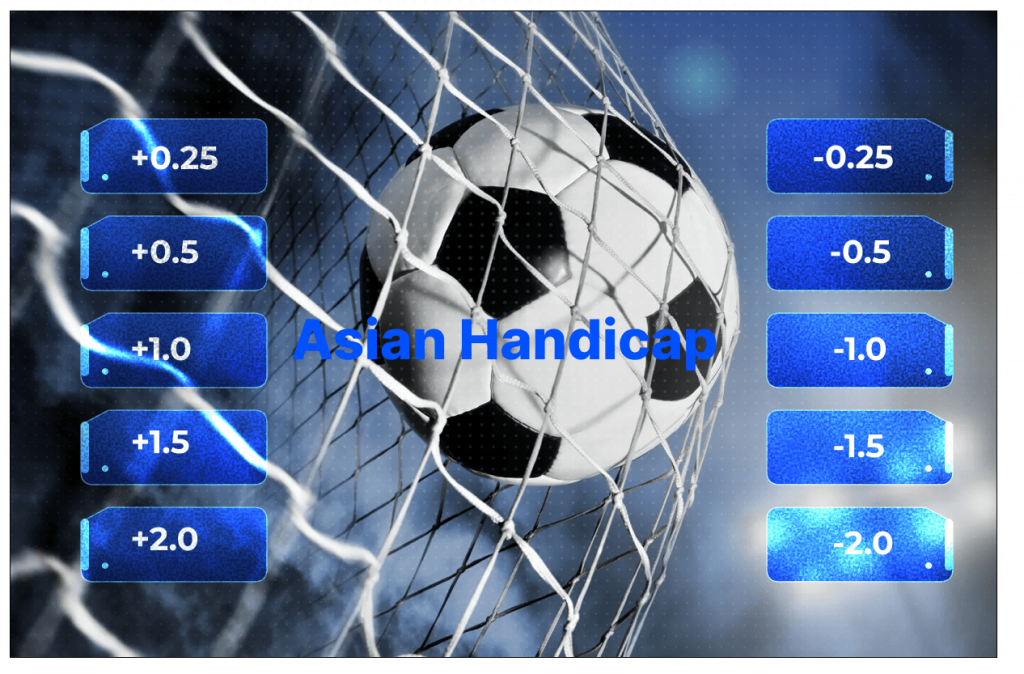
Asian handicap removes the draw and shifts the probability between the two sides. Instead of three outcomes, you are left with two. The bookmaker adjusts the line by giving one team a virtual advantage or disadvantage.
Example:
- Team A -1
- Team B +1
This means:
- Team A needs to win by 2+ goals to win the bet
- If they win by exactly 1 — the stake is refunded
- Any other result — the bet loses
You are betting on the same match, but from a shifted starting point.
Why Asian Handicap Exists
Asian handicap exists to balance pricing, not to simplify betting. In a standard 1X2 market, probability is split across three outcomes, which spreads the margin across all sides. Asian handicap reduces the market to two outcomes and concentrates pricing around a single line.
As a result:
- tighter odds
- often lower margin
- faster reaction to new information
These markets are easier to balance, especially in high-volume leagues. For bettors, this means pricing behaves more efficiently.
How to Read Asian Handicap Lines
Once you understand how Asian handicap shifts the starting point, the next step is reading the lines correctly. Each line represents a goal difference applied before the match starts. Your bet is evaluated against the final score after that adjustment.
Whole Lines (0, -1, +1)
- AH 0 (Draw No Bet)
→ win = win
→ draw = refund
→ loss = loss - AH -1
→ win by 2+ = win
→ win by 1 = refund
→ draw or loss = loss - AH +1
→ win or draw = win
→ loss by 1 = refund
→ loss by 2+ = loss
These lines include a push, where your stake is returned.
Half Lines (-0.5, +0.5)
Half lines remove the possibility of a refund.
- AH -0.5
→ must win - AH +0.5
→ win or draw
Quarter Lines
They split your stake into two separate bets.
Quick Decoder
- -0.25 = half on 0 and half on -0.5
- +0.25 = half on 0 and half on +0.5
- -0.75 = half on -0.5 and half on -1
- +0.75 = half on +0.5 and half on +1
You are not placing one bet. You are placing two smaller bets at the same time.
Example: Team A -0.25
Stake: $100
Split into:
- $50 on AH 0
- $50 on AH -0.5
Outcomes:
- Team wins → full win
- Draw → half loss (one refunded, one lost)
- Team loses → full loss
Example: Team A -0.75
Stake: $100
Split into:
- $50 on AH -0.5
- $50 on AH -1
Outcomes:
- Win by 2+ → full win
- Win by 1 → half win (one wins, one refunded)
- Draw or loss → full loss
You don’t need to memorize every variation. If you understand how the stake is split, you can read any Asian handicap line.
How Payouts Work
Asian handicap payouts depend on how your line interacts with the final score. The main difference appears on quarter lines, where outcomes can be split.
Quick Payout Table (Quarter Lines)
Quarter lines are easiest to read through score margins.
| Line | Win by 2+ | Win by 1 | Draw | Loss by 1 | Loss by 2+ |
| -0.25 | Full win | Full win | Half loss | Full loss | Full loss |
| +0.25 | Full win | Full win | Half win | Full loss | Full loss |
| -0.75 | Full win | Half win | Full loss | Full loss | Full loss |
| +0.75 | Full win | Full win | Full win | Half loss | Full loss |
Quarter lines don’t just change outcomes. They change how much you win or lose on the same result.
Example:
- Team wins by 1
- AH -0.5 → full win
- AH -0.75 → half win
Same match. Different payout. That difference is where risk and pricing meet.
Asian Handicap vs 1X2
Asian handicap and 1X2 often represent the same underlying outcome — but not the same price. This is where bettors lose edge.
Same Outcome ≠ Same Price
Example:
- Team A to win → 1.85
- Team A -0.5 → 1.80
These bets are identical in outcome. But one gives you a worse price. If you don’t compare, you lose value before the match even starts.
How the Line Changes the Bet
Asian handicap changes how prediction is priced. Instead of choosing “win or not”, you shift the line.
- Strong favorite
→ lower odds on 1X2 vs AH -1 - Balanced match
→ draw risk in 1X2 vs AH 0 - Underdog
→ high variance vs AH +0.5 or +1
Risk vs Price
Every line is a trade-off.
- Lower line → higher probability, lower payout
- Higher line → lower probability, higher payout
Example:
- AH -0.25 → higher chance to recover part of the stake
- AH -0.5 → full win or full loss
Same read. Different risk profile.
Where Mistakes Happen
- Treating Asian handicap as “safer betting”
It reduces variance, but does not create value - Not comparing equivalent bets
Same outcome can have different odds - Ignoring how the line affects payout
Quarter lines change how much you win, not just if you win
When Asian Handicap Makes Sense
Asian handicap matters most when your edge is marginal. When the difference between your number and the market is small, line selection becomes part of the decision.
Small Edge Situations
In most matches, your edge is small. Instead of full exposure through 1X2, you adjust the line:
- AH -0.25 reduces downside
- AH 0 removes draw risk
You are changing how the bet pays out, not improving your prediction.
Balanced Matches
When teams are close, a large part of probability sits in the draw. 1X2 forces you to take a position against it. Asian handicap lets you avoid that:
- AH 0 removes the draw
- AH ±0.25 adds controlled exposure
Underdog Positions
Underdogs come with high variance. Instead of betting on a low-probability win, you can shift the line:
- +0.5 or +1
This changes how often you lose, not what you expect to happen.
Connection to Closing Line
Asian handicap lines often move earlier than 1X2. If you consistently beat the closing line here, it means:
“You are entering the market at better prices than it settles on.”
If not, the issue is not the format. It is your price. Asian handicap is not a strategy. It is a way to structure risk around a price. It gives more control over variance, but does not create value on its own. If the price is wrong, the line will not fix it.